
"Doubt: A Parable" Strives for Nothing More Than Adequate and Average
Scott Ellis directs this over-cautious and flat revival of a tale of abuse, morality and responsibility in the Catholic Church.

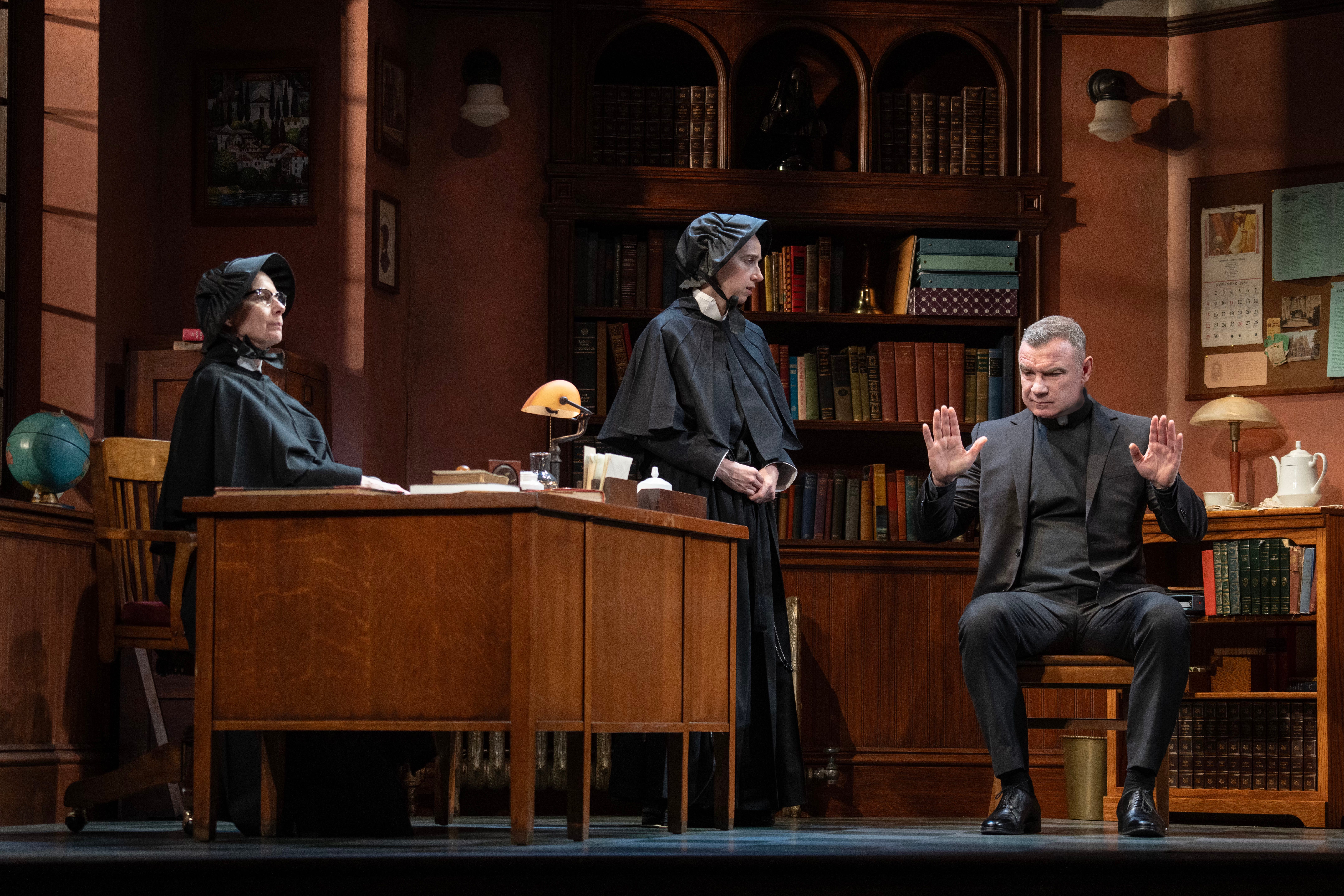
An exploration through the eyes of a sparring nun and priest of how the power dynamics of the Catholic Church have for generations allowed sexual abuse and other horrific abuses to proliferate within its priesthood certainly makes for an intriguing and worthwhile dramatic premise—at least on paper. Doubt: A Parable, a new play that opens this month at the newly-renamed Todd Haimes Theatre on Broadway, seeks to explore this topic. For its occasional successes and sharpness, most of the show’s ninety minutes unfold far too rapidly and without the necessary weight or intensity that such grave subject matters demand in an artistic setting such as this one.
Set in a Catholic primary school in the Bronx in the mid-1960s, Doubt tells the story of Sister Aloysius Beauvier (Amy Ryan), the school’s intimidating principal, a strict disciplinarian with a strong sense of duty to the well-being and education of the students in her care. Lamenting the changing cultural tides and loss of traditional values and influence of the Church, she encourages caution to one of the school’s teachers, Sister James (Zoe Kazan), a young, perhaps naive nun full of joy and enthusiasm.
Having recently enrolled the first African American student, Donald Muller, at the school, Sister Aloysius notices how the parish’s priest, Father Flynn (Liev Schreiber), has taken the boy under his wing and frequently invited him—alone—into his office. Suspicious of the nature of Flynn’s interest in Muller, she confronts Flynn about the matter, implying her accusation of abuse. Flynn offers a plausible explanation for his interest, which convinces Sister James of his innocence. However, Sister Aloysius remains in doubt and seeks his removal from her school and the parish.
As a late addition to the cast of this production, Amy Ryan struggles to convey the development of Sister Aloysius’ arc throughout the story. She adeptly inhabits the Sister’s early reticence at the modernizing world around her, and the use of restrained speech patterns and mannerisms works well in the initial scenes to establish her role as a strict disciplinarian and devotee to her life’s work. However, as the emotional and moral stakes escalate, this rigid performance doesn’t keep the audience informed as her confidence in her accusation softens, risking dehumanizing her entirely to a nearly as problematic leader—albeit in a very different way—from the man she accuses.
In the role of Father Flynn, Liev Schreiber is the highlight of the small cast. His portrayal of the abusive priest is remarkably human and deftly captures how more noble traits—however few they may be—act to hide his wrongdoing and complicate his moral arc with a few positive attributes. Flynn isn’t the stereotypical bad guy or absolute villain we may want him to be. He’s a complex, deeply-broken man who has failed to choose a virtuous path.
The remaining cast members fill their roles adequately but don’t stand out after the curtain falls. Zoe Kazan’s Sister James is sometimes amusing and mostly hopelessly naive. At the same time, Quincy Tyler Bernadine’s one-scene appearance as Muller’s mother doesn’t leave much of an impression, only adding a further complication to the plot that is seemingly never addressed throughout the show’s duration.
Thus far, this review probably comes across as somewhat harsh—which isn’t entirely fair. Doubt: A Parable is not a poorly made, acted, or written show. But, for such a heavy subject, I expected something with more depth that explores the uncomfortable complexities and realities of the situation our characters find themselves in. Those opportunities are there, but the author and director (John Patrick Shanley and Scott Ellis, respectively) both seem hesitant to pull on these loose threads, opting instead for a more straightforward story of good-versus-evil with a dash of the classic “old people looking down on the younger generation’s bucking of tradition” trope.
From a production perspective, Doubt is a beautiful piece of art. The set, designed by David Rockwell, is a lovely recreation of the stone Gothic architecture that many New England churches feature. Even more beautiful is Kenneth Posner’s lighting design, which, while subtle, adds to the visual beauty of each scene and directs our focus to where it should be.
If the premise of Doubt sounds particularly interesting and you are willing to moderate your expectations, the show is a decent outing to the theater. It is adequate in its narrative and average in its execution. While that will surely disappoint some, it leads to a perfectly fine show for others. So see it, don’t see it, just know that there are certainly better shows on Broadway--and worse ones, too.
“Doubt: A Parable” is currently running at the Todd Haimes Theatre through April 14, 2024.